Read the decline before retrying.
The gateway outcome and decline classification determine whether continuation is allowed. A response that should stop the sequence does so before the next candidate is attempted.

Continue an eligible payment with a defined route, a bounded number of attempts and a clear stopping point.
The gateway outcome and decline classification determine whether continuation is allowed. A response that should stop the sequence does so before the next candidate is attempted.
Connect the initial route to the accounts intended for continuation. Set retry depth and gateway-category preferences so fallback follows the policy your team chose.
Fallback still respects supported cards and account capacity. An account already tried for the order is excluded from another pass.
See the accounts tried, the responses received and the candidates skipped. The final outcome has a trail your operators can investigate.
Start with decline eligibility. Retrying a response that cannot benefit from another attempt consumes time without creating a useful alternative.
Success and stop-classified responses end the cascade rather than triggering another account.
Use a dedicated cascade pool and a maximum depth. Prefer or require matching gateway categories and limit candidates per category where the operation requires it.
Fallback is bounded by configuration and the candidates that remain eligible.
Inspect which attempt changed the outcome and why alternatives were skipped. Keep the first attempt and its continuation connected to the same order.
Attempt history makes it possible to evaluate the policy without treating each retry as an unrelated sale.
Give eligible failures another path while preserving the stop rules, capacity checks and operational history that make continuation manageable.
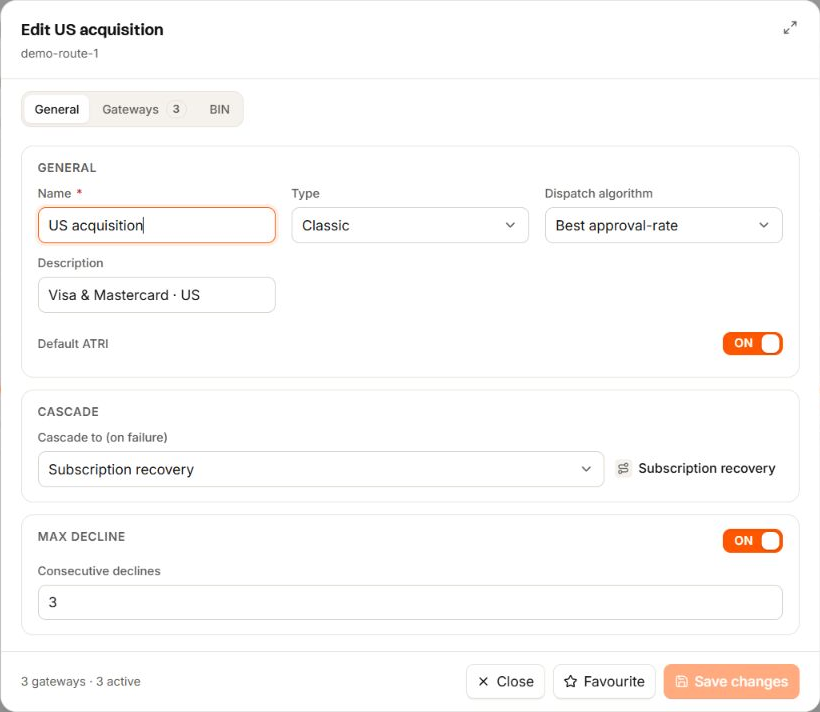
Continue where gateway response and decline classification allow it.
Bound cascade depth and candidates per category.
Give the cascade its own membership and ordering.
Review each account, outcome and skip reason.
Choose the initial route and linked cascade pool.
Set retry depth and category preferences.
Inspect the attempts and final outcome.
No. The decline engine evaluates whether another MID can plausibly help. Definitive card problems and other non-retryable responses are treated differently from recoverable failures.
Yes. Cascade depth limits the number of MIDs attempted, and category policies can narrow or prioritize the fallback pool.
An ambiguous timeout is recorded as an unknown outcome. Further failover depends on the configured timeout policy and the payment flow's safeguards.
Yes. A dedicated cascade pool can have its own membership and ordering.
Attempt history records the account, outcome and skip reason so the full path can be reviewed.
Routing selects the first eligible destination. Cascading is a possible continuation after that attempt returns a result, subject to its own rules and limits.
No. A cascade concerns payment attempts. Cart recovery uses email or SMS to bring a customer back to an unfinished purchase.
Choose the initial route and linked cascade pool, then set the retry depth and category preferences.

Let’s connect your checkout, payments and recurring revenue.
See what your operation could look like.