Block known unwanted attempts.
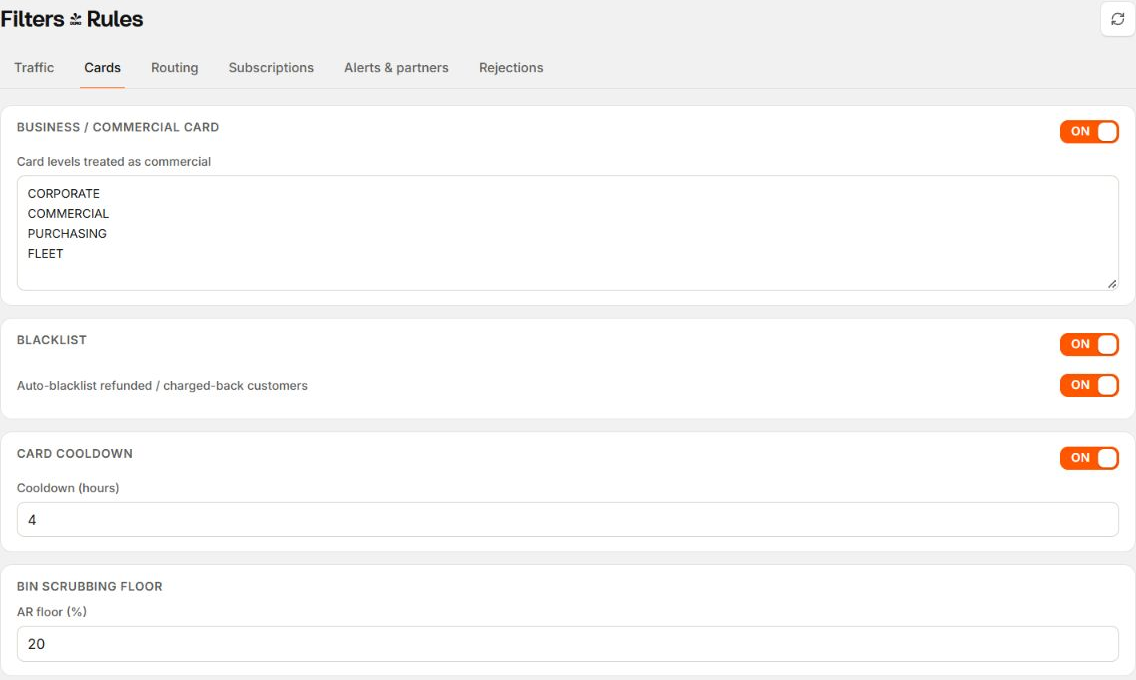
Enabled card and email blacklists run before routing. Keep the entries your team has decided to refuse in the payment policy itself.

Use explicit payment controls to distinguish a policy refusal from a processor’s decline.
Enabled card and email blacklists run before routing. Keep the entries your team has decided to refuse in the payment policy itself.
Configure velocity controls and cooldown for previously rejected cards. Recurring billing also includes a duplicate-card guard for its own charging context.
Combine initial-payment filters, validity checks and BIN scrubbing where they belong. Select the scope of the rule instead of treating every payment type identically.
A policy refusal is recorded separately from a gateway decline. Your team can inspect what stopped the payment before changing another part of the route.
Start with known card and email entries, initial-payment rules and the relevant BIN profiles. Keep each rule connected to a concrete operating reason.
A refusal that belongs before routing should be evaluated before an account is attempted.
Set the velocity and rejected-card cooldown policy. Review recurring duplicate-card handling separately from the rules for a new purchase.
Repetition has a transaction context; a new customer action and an additional billing attempt are different situations.
Read the recorded refusal reason and affected payment. Add authentication or supported dispute alerts when the problem calls for those controls.
Specific controls make decisions explainable without reducing every failure to a generic fraud label.
Keep your pre-charge policy specific, inspectable and connected to the rest of the operation, so the team can refine the right control.
Refuse matching identities before routing when enabled.
Apply initial-order checks and inspect filter-hit history.
Check validity and apply the configured rejection cooldown.
Combine pre-processing policy with supported 3D Secure and BIN profiles.
Enable the filters and profiles that fit the operation.
Apply checks before the payment reaches a merchant account.
Review refusal reasons separately from gateway declines.
Combine order and velocity rules, customer or card blacklists, BIN scrubbing, 3D Secure policies and supported dispute-alert connections.
No. Authentication can be frictionless or require a browser challenge, and the issuer has the final say.
Supported alert integrations include an optional automatic-refund setting. The specific behavior depends on the provider and account configuration.
Enabled email and card blacklists can refuse matching identities before the payment is routed.
Yes. Configure the initial-order checks and review the filter-hit history.
The card-check configuration can apply a cooldown following a rejection, alongside the configured validity checks.
Yes. Pre-processing policy can be combined with the relevant BIN mapping or scrubbing profiles.
Supported 3D Secure integrations provide a separate authentication layer governed by their provider and rule configuration.

Let’s connect your checkout, payments and recurring revenue.
See what your operation could look like.