Pixels at the right level.
Set account, store or product pixels. A product override replaces that network’s store default while the other networks retain their own settings.

Configure the right pixels for the offer and send each network the supported events that belong to it.
Set account, store or product pixels. A product override replaces that network’s store default while the other networks retain their own settings.
Use supported click identifiers and traffic context to identify the attributed network. Keep the checkout’s acquisition context connected to the order outcome.
Meta, TikTok and Snapchat support browser and server conversion paths with coordinated event IDs. Google Ads has an approved-order conversion upload flow.
Inspect recent activity, pixel scope, missing server credentials and blocked SDK signals. Find the event path that needs attention before changing the campaign.
Configure each network at the appropriate scope. Product-specific pixels let a distinct offer use its own destination without replacing unrelated network settings.
Supported networks include Meta, TikTok, Google Ads, Snapchat, Pinterest, AppLovin and X Ads.
Carry supported click identifiers and UTM context through checkout. Attribute the approved outcome using the network-specific path rather than broadcasting every sale everywhere.
Browser-only integrations and server conversion integrations retain their distinct delivery mechanisms.
Use pixel audit signals to review recent firing and configuration gaps. Connect the pixel, its scope and event activity when investigating a missing conversion.
For Pinterest, AppLovin and X, the supported integration is the browser path.
Give each supported network the purchase context its integration expects, with enough visibility to investigate the path when something is missing.
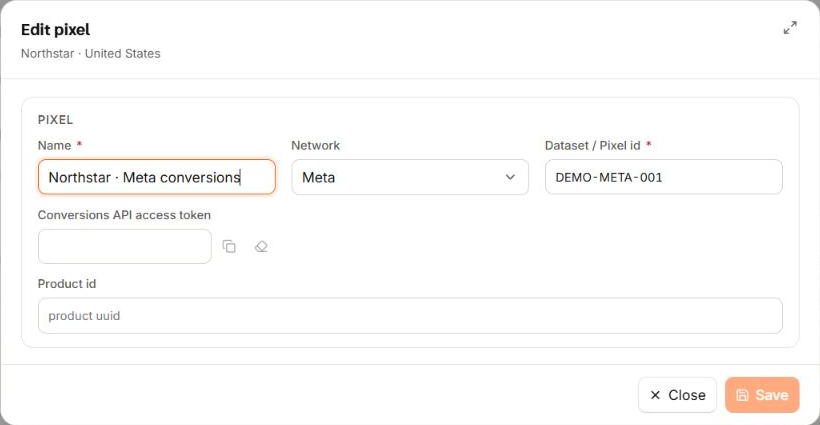
Choose account, store or product scope with per-network overrides.
Keep supported click identifiers and UTM attribution with checkout.
Configure Meta, TikTok and Snapchat server events, Google uploads and supported browser pixels.
Inspect credentials, fired-event counts, latest activity and blocked SDK signals.
Keep the originating affiliate and supported pixel configuration with the saved offer link across the flow.
Configure the network and scope for the pixel.
Carry campaign context through checkout.
Review event activity and the payment outcome.







No. Meta, TikTok and Snapchat support server conversion paths; Google Ads uses an upload flow. Pinterest, AppLovin and X use browser integrations.
Yes. A product-scoped pixel can override the store pixel for that network while retaining the defaults for other networks.
Supported click identifiers and UTM context are carried with checkout attribution.
The supported setup includes Meta, TikTok and Snapchat server events, Google uploads and supported browser pixels. Each network has its own configuration.
Pixel audit views include credentials, fired-event counts, latest activity and blocked SDK signals.
Experiment and checkout identities stay associated with their events and transactions, helping compare the purchase experience behind a result.
No. Event delivery and the network’s attribution result are distinct. Review the configured event path, campaign context and the network’s own reporting.
Inspect the pixel scope and latest activity, then check blocked SDK signals and the actual payment outcome. This separates a purchase problem from an event-delivery problem.

Let’s connect your checkout, payments and recurring revenue.
See what your operation could look like.