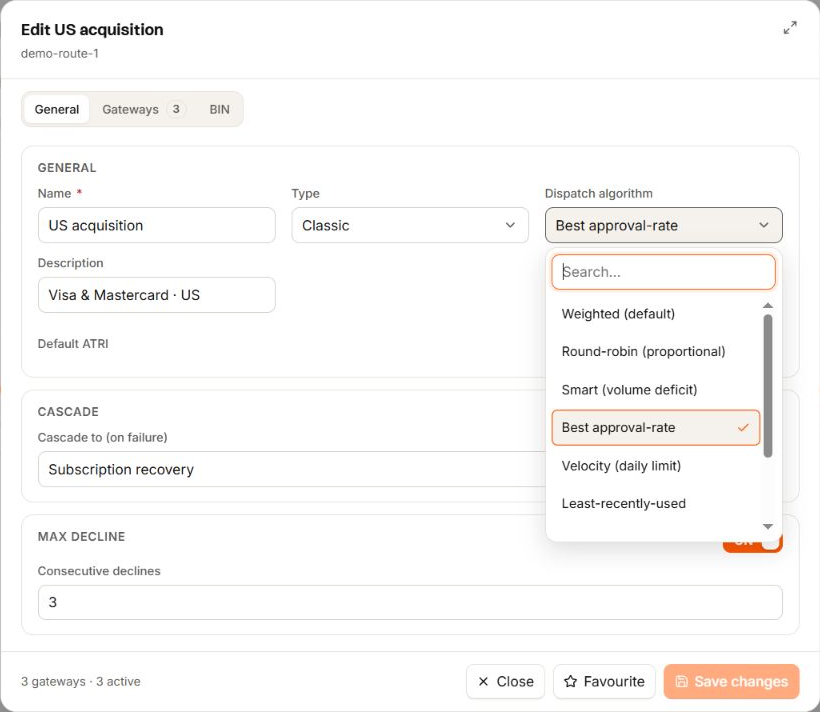
Every route needs a reason.Make yours explicit.

Need more visibility into how payments reach your merchant accounts? Compare Kontrol and Tagada across allocation, capacity and checkout reporting.

Kontrolvs
Account allocation
Checkout reporting
Comparable pricing

Compare what matters.
Choose for your operation.

Published capabilities and pricing, reviewed on 21 October 2026.

Kontrol and Tagada platform comparison. Check marks indicate a documented capability, not equivalent implementation. Full details and sources follow.
FeaturesKontrol
Checkout & funnelsAvailableAvailable
Routing & recoveryAvailableAvailable
Billing & messagingAvailableAvailable
Developer integrationServer-side APIsAPIs + SDKs
Tracking & A/B testsAvailableAvailable
Platform pricing$799/moFixed monthly subscription$75/week+ 1.25% + $0.29/txn

Documented capability · A dash means the reviewed material does not establish the scope.

View feature details and sources

Checkout and funnel creation

Kontrol

Kontrol offers Funnel Builder and post-purchase upsells; checkout profiles combine reusable blocks, catalog offers, payment pools and authentication settings.

Tagada

TagadaStudio provides visual page building, responsive layouts and native checkout, offers and payment components.

Evaluate Kontrol when a checkout profile should carry presentation and payment configuration together. Both products offer funnel building; compare the required design and offer workflow directly.

Orchestration and recovery

Kontrol

Operators set MID allocation, monthly caps, BIN mappings, refusal scopes and maximum cascade depth with attempt histories.

Tagada

Tagada describes multi-processor routing, decline cascades and retries, including an optional native processor.

Kontrol is a candidate when the selection depends on these concrete routing and refusal controls. The reviewed Tagada pages do not establish whether every equivalent setting is available.

Subscriptions and messaging

Kontrol

Introductory billing cycles, scheduled recurring retries and configured abandoned-cart email/SMS follow-up are available.

Tagada

The plan lists recurring billing, dunning, failed-payment recovery and email/SMS automation.

Kontrol fits teams requiring those defined billing and recovery mechanisms. Separate scheduled charge retries from messaging when comparing either platform.

Developer integration

Kontrol

Server-side endpoints cover charges, status, 3DS sessions, account administration and reporting.

Tagada

Official docs describe Node, headless and plugin SDKs, a REST API, CLI tools, MCP servers and a sandbox.

Choose Kontrol when its API families match a server-side integration. Tagada's documented SDK and tooling breadth is a real evaluation advantage for developer-led teams.

Tracking and experimentation

Kontrol

Cart-level checkout experiments retain variant attribution; supported ad events connect to payment outcomes and eligible Google Ads purchases.

Tagada

Tagada's included features list A/B tests, server-side tracking and analytics.

Kontrol is worth testing when variant-to-payment attribution is central. Both products advertise experimentation and tracking, with integration-specific prerequisites.

Fee structure

Kontrol

$799 USD/month is the stated platform formula.

Tagada

The base CRM rate combines 1.25% and $0.29 per successful transaction, plus $75/week; discounts have conditions.

Kontrol uses a lower published percentage and a different fixed-fee structure. Compare total charges for the actual volume, order count and processing arrangement.


Where Kontrol can be
the stronger fit.

A clear monthly platform base

Kontrol publishes $799 USD per month. Compare that subscription with Tagada’s weekly base and transaction fees using the terms that apply to your processing setup.

Explicit allocation choices

Configure allocation, capacity and BIN rules for supported merchant accounts. Keep the reasons for attempted and skipped routes visible to the operations team.

Checkout and payment reporting together

Review the checkout variant alongside payment outcomes and supported source dimensions. Use the same operating view to investigate what happened after a campaign click.

Make the pricing period and operating scope comparable.

Bring the same stores, sales volume and processing requirements to both evaluations before comparing the headline fee.

What is the cost over the same period?

Convert weekly and monthly platform charges to a consistent planning period. Include transaction-based charges and the terms attached to the processing setup.

Which account takes the next payment?

Ask to see allocation settings, account headroom and card rules. In Kontrol, operators can configure those priorities and inspect the reasons behind selected and skipped accounts.

Can the team follow a campaign into payment?

Compare how source context, checkout variants and completed transactions can be investigated. Use an actual reporting question rather than only looking at the dashboard totals.

Keep the offer and route in the same operating picture.

  1. Connect the purchase destination.

    Assign the published checkout or flow serving the store. Configure supported pixel destinations at the appropriate scope.

  2. Define the account policy.

    Choose the routing pool, allocation strategy and card rules. Capacity checks narrow the eligible accounts.

  3. Read the connected outcome.

    Review checkout performance and payment results by the relevant source, store or account. Use the detail to choose the next change.

See it in your operation.

Use the same offer, accounts and operating questions when you compare your options.

ATRI routing strategy controls

Look inside the capabilities.

Payment Routing

Bring account capacity, card policy and allocation priorities into the same payment decision, then inspect the path it actually took.

Enhanced Ads Tracking

Give each supported network the purchase context its integration expects, with enough visibility to investigate the path when something is missing.

Advanced Reporting

Keep the route, purchase experience and financial components close enough to investigate a change while it still matters.

Put the full cost
on the table.

Compare platform fees, payment processing, add-ons and your required setup on the same basis.

See Kontrol’s platform price
Kontrol

$799 USD/month
Gateway, acquiring, third-party services and applicable taxes are separate.

Tagada

Base CRM: 1.25% + $0.29 per successful transaction plus $75/week. The FAQ says the weekly fee is waived when variable transaction fees exceed $50,000/month; the headline abbreviates this to above $50K/mo. TagadaPay processing of $50K+/month reduces the CRM percentage to 0.8%; processor fees remain separate. Custom rates are offered above $500K/month. Confirm the waiver basis directly.

Make the decision with the details.

Competitor information comes from the official pages below. A feature that is not described in those pages is not treated as unavailable. Plans, availability and pricing can change; confirm the scope of your quote and the configuration you need.

Tagada’s headline and FAQ describe the weekly-fee waiver differently. Confirm the waiver threshold and the effect of TagadaPay on the applicable CRM rate.

Official sources for this comparison

Names and logos identify the platforms compared. No affiliation or endorsement is implied.

A closer look at the comparison.

How do Kontrol and Tagada compare on checkout and funnel creation?

Tagada: TagadaStudio provides visual page building, responsive layouts and native checkout, offers and payment components. In Kontrol: Kontrol offers Funnel Builder and post-purchase upsells; checkout profiles combine reusable blocks, catalog offers, payment pools and authentication settings.

How do Kontrol and Tagada compare on orchestration and recovery?

Tagada: Tagada describes multi-processor routing, decline cascades and retries, including an optional native processor. In Kontrol: Operators set MID allocation, monthly caps, BIN mappings, refusal scopes and maximum cascade depth with attempt histories.

How do Kontrol and Tagada compare on subscriptions and messaging?

Tagada: The plan lists recurring billing, dunning, failed-payment recovery and email/SMS automation. In Kontrol: Introductory billing cycles, scheduled recurring retries and configured abandoned-cart email/SMS follow-up are available.

How do Kontrol and Tagada compare on developer integration?

Tagada: Official docs describe Node, headless and plugin SDKs, a REST API, CLI tools, MCP servers and a sandbox. In Kontrol: Server-side endpoints cover charges, status, 3DS sessions, account administration and reporting.

How do Kontrol and Tagada compare on tracking and experimentation?

Tagada: Tagada's included features list A/B tests, server-side tracking and analytics. In Kontrol: Cart-level checkout experiments retain variant attribution; supported ad events connect to payment outcomes and eligible Google Ads purchases.

How do Kontrol and Tagada compare on fee structure?

Tagada: The base CRM rate combines 1.25% and $0.29 per successful transaction, plus $75/week; discounts have conditions. In Kontrol: $799 USD/month is the stated platform formula.

Where can I verify the Tagada information?

The official source links are included on this page. The research was reviewed on 21 October 2026; confirm current packaging, provider compatibility and commercial scope directly before selecting a platform.

Does this comparison establish that either platform lacks an unlisted feature?

No. A public source may omit a capability. Treat unverified details as questions for the vendor, not proof that the feature is unavailable.

Your next chapter.
Under Kontrol.

Let’s connect your checkout, payments and recurring revenue.
See what your operation could look like.

Start nowExplore pricing