Your recovery rules.Your team in control.

Want to operate payment recovery directly? Compare how Kontrol combines decline eligibility, routing and recurring retry controls with Apptics’ offering.

Kontrolvs
Decline eligibility
Recovery controls
Full platform cost

Compare what matters.
Choose for your operation.

Published capabilities and pricing, reviewed on 21 October 2026.

Kontrol and Apptics platform comparison. Check marks indicate a documented capability, not equivalent implementation. Full details and sources follow.
FeaturesKontrol
Checkout & A/B testsAvailableAvailable
BIN routingAvailableSeparate scrubbingAvailable
Decline recoveryAvailableConfigured rulesAvailableEnterprise plan
Subscription billingAvailableOperator controlsAvailableToken vaulting
Risk operationsAvailableAvailable
Operational reportingAvailableAvailable

Documented capability · A dash means the reviewed material does not establish the scope.

View feature details and sources

Checkout and testing

Kontrol

Reusable checkout profiles connect block layouts and catalog offers to routing, wallets and 3DS; tests support 2–20 profiles.

Apptics

Both published plans list a checkout builder, split tests and customizable upsell/downsell flows.

Evaluate Kontrol when the experiment needs to carry the checkout profile through pricing, payment routing and transaction reporting. Both products advertise checkout testing.

BIN and routing controls

Kontrol

BIN mapping can target MIDs, processors, acquirers, MCCs or pools; separate scrubbing profiles can refuse initial charges, rebills or both.

Apptics

Apptics lists payment orchestration and BIN-based routing in Starter and Enterprise.

Kontrol provides concrete controls for teams that need to distinguish payment allocation from pre-processing refusal. This is a fit criterion, not evidence that Apptics lacks equivalent controls.

Decline recovery

Kontrol

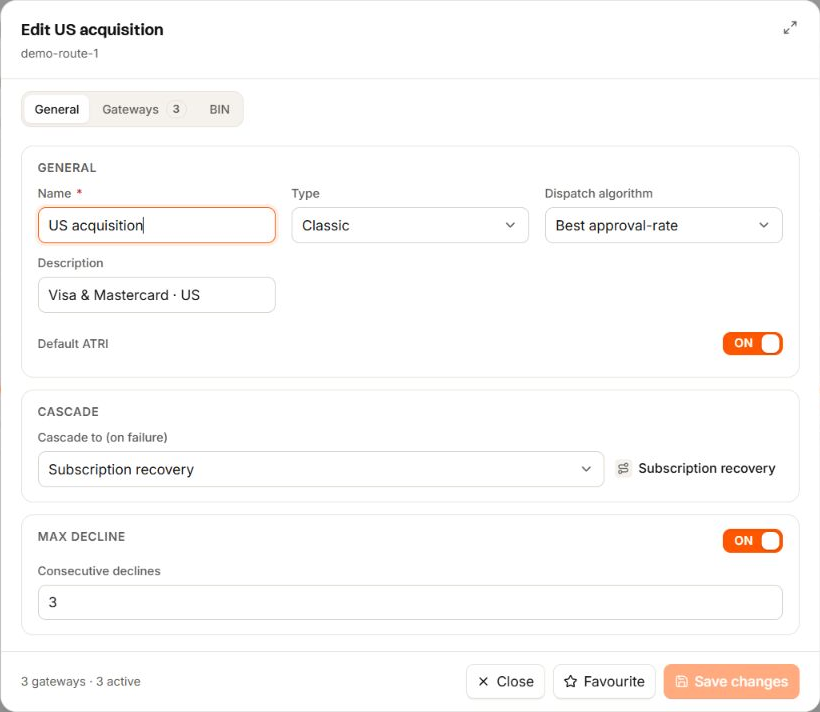
Configure response classification, maximum cascade depth, category limits and recurring retry delays.

Apptics

The plan table reserves AI Smart Retry & Salvage for Enterprise.

Kontrol fits operators who want to set retry boundaries and inspect attempt or skip reasons. It does not promise the same AI behavior or recovery results.

Subscriptions and stored credentials

Kontrol

Manage introductory cycles, recurring intervals, pause/resume/cancel and retention reporting. Confirm token portability and network-token requirements for your supported provider.

Apptics

Apptics markets subscription vaulting and merchant control of payment tokens for migration or rerouting.

Choose Kontrol for the documented billing and routing workflow when its supported providers fit. Treat portable vaulting as a separate Apptics capability to validate during evaluation.

Risk operations

Kontrol

Enabled blacklists, velocity filters, 3DS provider policies and XCaliber or RCVR alert actions work within the payment operation.

Apptics

Apptics Shield brings together fraud prevention, dispute alerts and automated resolution.

Kontrol is a candidate when the team needs to operate these configured checks alongside routing. Neither product's feature list proves a chargeback or fraud outcome.

Operational reporting

Kontrol

Reports break down outcomes by MID, processor, acquirer, entity, store, product and traffic source, with account-scoped reporting APIs.

Apptics

Apptics describes reporting on retention, approvals, recovery, customer lifetime value and payment performance.

Evaluate Kontrol when those payment-operation dimensions and API access match the team's reporting requirements; analytics itself is shared ground.


Where Kontrol can be
the stronger fit.

One fixed platform subscription

Kontrol is $799 USD per month with no sales-based platform fee. Compare this with the base fees and percentages on Apptics’ published plans, then account for processor and service scope.

Recovery rules you operate

Set decline eligibility, cascade limits and recurring retry delays. Review the attempt history when your team needs to understand why a payment stopped or continued.

Map and scrub separately

Use BIN mapping to choose an eligible route and scrubbing profiles to refuse an ineligible attempt. These are distinct controls within the same operation.

Compare how the recovery policy is operated.

Beyond the headline feature list, follow one initial decline through the rules, fallback route and final record.

Who decides whether a decline can continue?

Ask to see the decline classification before another account is attempted. In Kontrol, response eligibility and the configured cascade boundaries determine whether continuation belongs in the flow.

Can the team explain the route?

Compare how each platform shows eligible accounts, skipped candidates and attempts already made. Bring a payment that should stop as well as one that should continue to the evaluation.

What does the quoted percentage include?

Model the monthly base, sales percentage, transaction charges and required services at your actual volume. Keep platform pricing separate from processing and alert-service costs.

Operate recovery with a visible reason at each step.

  1. Set the policy.

    Configure the initial pool, BIN profiles, decline eligibility and bounded cascade route. Keep the choice between mapping and scrubbing explicit.

  2. Follow the attempt.

    Inspect the gateway response and next eligible candidate. Capacity and card support continue to apply during fallback.

  3. Review the outcome.

    Read the attempts and final transaction together. Use the recorded sequence when changing a recovery rule.

See it in your operation.

Use the same offer, accounts and operating questions when you compare your options.

Cascade attempt limits and cross-account controls

Look inside the capabilities.

Smart Cascade

Give eligible failures another path while preserving the stop rules, capacity checks and operational history that make continuation manageable.

BIN Mapping & Scrubbing

The rules your team learns belong in reusable profiles, with enough detail to understand their effect and change them deliberately.

Payment Routing

Bring account capacity, card policy and allocation priorities into the same payment decision, then inspect the path it actually took.

Put the full cost
on the table.

Compare platform fees, payment processing, add-ons and your required setup on the same basis.

See Kontrol’s platform price
Kontrol

$799 USD/month
Gateway, acquiring, third-party services and applicable taxes are separate.

Apptics

Starter: $750/month plus 1.9% + $0.29 per transaction; additional stores $250/month each. Enterprise: $2,500/month plus 1.75% + $0.19 per transaction, including five stores. The optional development-team add-on is $1,000/month. Kontrol's published platform price is $799 USD/month; compare fee scope and processor charges before calculating total cost.

Make the decision with the details.

Competitor information comes from the official pages below. A feature that is not described in those pages is not treated as unavailable. Plans, availability and pricing can change; confirm the scope of your quote and the configuration you need.

Official sources for this comparison

Names and logos identify the platforms compared. No affiliation or endorsement is implied.

A closer look at the comparison.

How do Kontrol and Apptics compare on checkout and testing?

Apptics: Both published plans list a checkout builder, split tests and customizable upsell/downsell flows. In Kontrol: Reusable checkout profiles connect block layouts and catalog offers to routing, wallets and 3DS; tests support 2–20 profiles.

How do Kontrol and Apptics compare on bin and routing controls?

Apptics: Apptics lists payment orchestration and BIN-based routing in Starter and Enterprise. In Kontrol: BIN mapping can target MIDs, processors, acquirers, MCCs or pools; separate scrubbing profiles can refuse initial charges, rebills or both.

How do Kontrol and Apptics compare on decline recovery?

Apptics: The plan table reserves AI Smart Retry & Salvage for Enterprise. In Kontrol: Configure response classification, maximum cascade depth, category limits and recurring retry delays.

How do Kontrol and Apptics compare on subscriptions and stored credentials?

Apptics: Apptics markets subscription vaulting and merchant control of payment tokens for migration or rerouting. In Kontrol: Manage introductory cycles, recurring intervals, pause/resume/cancel and retention reporting. Confirm token portability and network-token requirements for your supported provider.

How do Kontrol and Apptics compare on risk operations?

Apptics: Apptics Shield brings together fraud prevention, dispute alerts and automated resolution. In Kontrol: Enabled blacklists, velocity filters, 3DS provider policies and XCaliber or RCVR alert actions work within the payment operation.

How do Kontrol and Apptics compare on operational reporting?

Apptics: Apptics describes reporting on retention, approvals, recovery, customer lifetime value and payment performance. In Kontrol: Reports break down outcomes by MID, processor, acquirer, entity, store, product and traffic source, with account-scoped reporting APIs.

How should I compare the total commercial cost?

Starter: $750/month plus 1.9% + $0.29 per transaction; additional stores $250/month each. Enterprise: $2,500/month plus 1.75% + $0.19 per transaction, including five stores. The optional development-team add-on is $1,000/month. Kontrol's published platform price is $799 USD/month; compare fee scope and processor charges before calculating total cost.

Where can I verify the Apptics information?

The official source links are included on this page. The research was reviewed on 21 October 2026; confirm current packaging, provider compatibility and commercial scope directly before selecting a platform.

Your next chapter.
Under Kontrol.

Let’s connect your checkout, payments and recurring revenue.
See what your operation could look like.

Start nowExplore pricing