Choose the distribution you need.
Balance weighted shares, spread orders with proportional round-robin or favour volume deficits. Choose a different strategy when approval history, configured cost or cap fill matters more.

A payment route is more useful when it accounts for allocation, headroom and the rules of the offer.
Balance weighted shares, spread orders with proportional round-robin or favour volume deficits. Choose a different strategy when approval history, configured cost or cap fill matters more.
Account headroom is checked with pending reservations, not just settled volume. An account that cannot accept the payment is skipped with a reason.
Attach BIN mapping and authentication profiles to the pool. The allocation strategy works within those controls instead of replacing them.
Constrain the account, category, acquirer, processor or company for a recurring charge. Define how those constraints relax when a strict match leaves no eligible route.
Select the merchant accounts that can serve a store or offer. Set the allocation shares and choose the strategy that reflects your processing priorities.
Nine dispatch strategies cover different allocation, history, cost and capacity priorities.
Card support, account headroom and attached policy profiles narrow the candidates. Ordering an account first does not bypass those checks.
The candidate list records why an account was skipped as well as the account eventually selected.
Use transaction history and account reporting to see where volume went. Update weights or capacity with the operating evidence in front of you.
Configured-cost ordering uses the transaction fee and discount rate entered for the account.
Bring account capacity, card policy and allocation priorities into the same payment decision, then inspect the path it actually took.
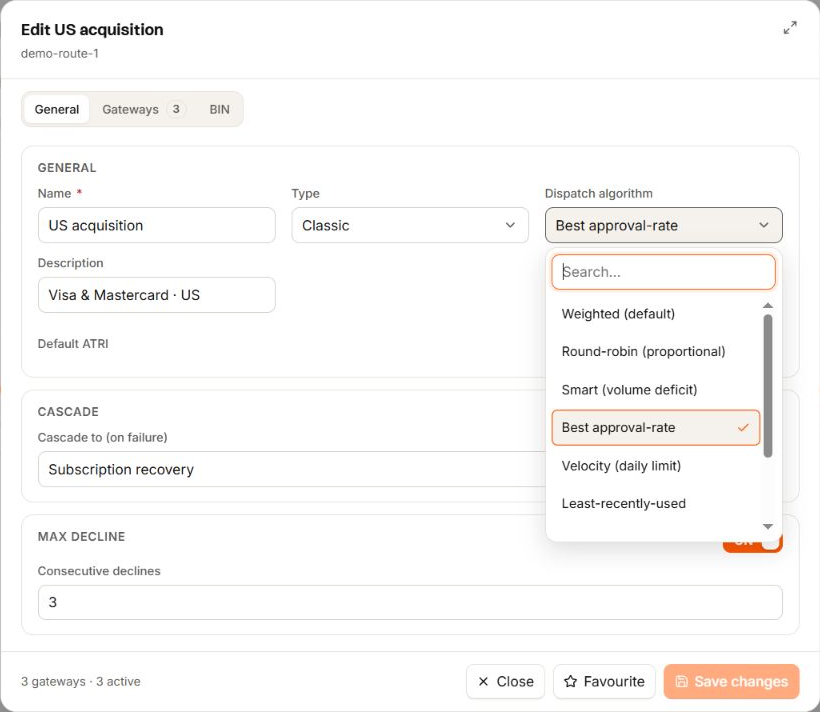
Choose the accounts in each pool and their allocation shares.
Weighted, round-robin, volume deficit, approval-rate, velocity, least-recently-used, configured cost, cap fill and random.
Include pending reservations when checking monthly account headroom.
Keep or rotate processing dimensions with a configured fallback order.
Group the accounts that can serve the offer.
Choose the strategy and attach the required rule profiles.
Follow the chosen route and the reasons candidates were skipped.
Smart volume-deficit allocation compares configured weights with actual volume and favours the account furthest below its share.
Yes. Cheapest cost orders eligible accounts using the configured transaction fee and discount rate for the payment amount.
Yes. Choose pool members and allocation weights, then apply the dispatch strategy that fits the operation.
The available strategies include weighted, round-robin, volume deficit, approval-rate, velocity, least-recently-used, configured cost, cap fill and random dispatch.
Yes. Pending reservations are included when checking monthly account headroom, so in-flight work is considered before dispatch.
Yes. Recurring settings can keep or rotate processing dimensions and define the fallback order.
The decision history records selected routes and skipped candidates, with the reasons available for investigation.
Attach the relevant mapping or scrubbing profile to the pool. Those rules refine the configured payment decision before dispatch.

Let’s connect your checkout, payments and recurring revenue.
See what your operation could look like.