Choose the provider and merchant identity.
Configure supported providers with the account’s merchant details and card networks. Keep authentication setup alongside the payment operation it serves.

Connect the provider, the card policy and the browser step instead of treating authentication as an isolated redirect.
Configure supported providers with the account’s merchant details and card networks. Keep authentication setup alongside the payment operation it serves.
Let the issuer decide, request a challenge or mandate one through configuration. The returned authentication path determines whether a browser step is needed.
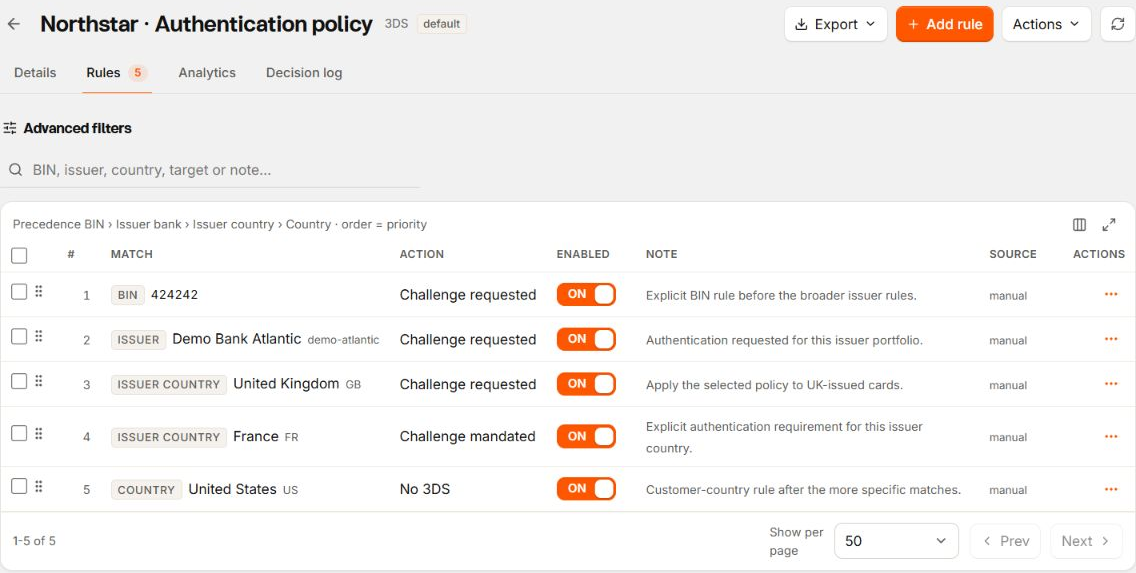
Match BIN, issuer, issuer country or customer country. Attach the reusable profile to a routing pool so the card context can refine the preference.
Inspect frictionless or challenge handling, status and authentication results. Configured attempt costs remain visible with the payment’s financial context.
Set up Evervault, PAAY, 3dsecure.io or VGS with the relevant credentials and merchant identity. Review the supported networks and provider settings together.
A provider configuration is a part of the payment setup, with its own credentials and operating choices.
Use a profile when the policy should vary by card or country. Pool assignment keeps the rule close to the accounts that will serve the payment.
The issuer controls the final authentication experience, including whether a challenge occurs.
The authentication session returns a browser action when one is required. Follow the resulting status before treating the payment journey as complete.
Headless integrations can coordinate the same lifecycle through the documented session endpoints.
Make the authentication preference explicit and keep the required browser action and its outcome connected to the purchase.
Connect credentials and merchant identity for a supported provider.
Choose the supported card networks that use the provider.
Request, mandate or skip authentication for matching rules.
Follow browser actions, status, outcomes and configured attempt fees.
Connect the provider and define its scope.
Apply profiles to the relevant routing pools.
Follow the session and payment outcome.




Supported integrations include Evervault, PAAY, 3dsecure.io and Very Good Security. Available card networks and production use depend on your provider and merchant configuration.
Yes. 3DS profiles can request or mandate a challenge preference for matching BINs, issuers or supported country rules. The issuing bank determines the authentication flow it actually presents.
No. Authentication and payment authorization are separate outcomes. Challenge behavior and any liability treatment depend on the issuer, network, provider and transaction.
Yes. The provider configuration includes supported card-network scope.
Yes. Matching profiles can request, mandate or skip authentication according to the configured rules.
Apply the relevant profiles to routing pools after connecting the provider credentials and merchant identity.
Session visibility includes browser actions, status and outcomes, as well as configured attempt fees.
No. Authentication and authorization are separate stages. Follow the session outcome and the resulting payment status.

Let’s connect your checkout, payments and recurring revenue.
See what your operation could look like.